Brewery Branding: A Practical Guide for Independent Breweries
Brewery branding is the strategy, story, identity, packaging and experience that shapes how people understand and choose your brewery.
It gives drinkers a reason to notice you, makes your beer range easier to navigate, helps trade customers understand why you belong on their bar and keeps the brewery recognisable as it grows.
Your logo is part of that. Your can designs are part of it. So are the words on your website, the way your sales team introduces the brewery, the atmosphere in your taproom and whether somebody can spot one of your pump clips from the other side of the pub.
A strong brewery brand should do five things:
Get noticed
Be understood
Make choosing easier
Be remembered
Give people a reason to return
If it is failing at one or more of those jobs, the problem can start showing up everywhere. Packaging blends into the fridge. The core range becomes difficult to recognise. Marketing takes more effort than it should. Sales teams struggle to explain why someone should choose you.
This guide explains what brewery branding actually involves, how the process works and how an independent brewery can build a brand that earns its keep.
What is brewery branding?
Brewery branding is the complete impression people form of your brewery.
Some of that impression is deliberately created through your strategy, identity, packaging, tone of voice and customer experience. Some of it develops through what people hear from friends, encounter in pubs, see online or experience when dealing with your team.
That means your brand does not live solely in a logo file or a set of brand guidelines. It lives in people’s heads.
When somebody hears your brewery’s name, what do they immediately associate with it?
Do they know what kind of brewery you are? Can they picture one of your beers? Do they understand what makes you different? Would they recognise your packaging without reading every word?
The strongest brewery brands make those answers easier.
They give the business a clear place in the market and then reinforce it consistently across every point where drinkers, publicans, buyers and retailers experience the brewery.
What does brewery branding include?
A complete brewery brand is made up of several connected parts. They each have a different job, but they need to work together.
Brewery brand strategy
Brand strategy gives the brewery direction before anyone starts designing labels or playing with typefaces.
It should define:
Who the brewery needs to reach
What those people care about
Where the brewery fits within the market
What makes it meaningfully different
What it wants to be known for
The personality it should communicate
The messages it needs to repeat
How the beer range should be organised
What commercial result the brand needs to support
Without that foundation, branding decisions become subjective.
One person wants the brand to feel traditional. Someone else wants it to feel disruptive. The sales team wants more clarity. The brewer wants every new release to have its own personality. The founder has spotted something they like on Instagram.
Before long, the range looks like six different breweries sharing a cold store.
A strategy gives everyone something more useful than personal taste to make decisions against.
Visual identity
A visual identity is the recognisable world built around the brewery.
It can include:
Logo and brand marks
Colour palette
Typography
Illustration
Photography
Graphic devices
Layout rules
Icons and supporting graphics
Motion and digital treatments
The goal is not to make every piece of communication identical. It is to build enough consistency that everything feels as though it comes from the same brewery.
A strong identity should be flexible enough to work across a flagship pale ale, a seasonal stout, a taproom event, a delivery van and an Instagram post without disappearing each time the format changes.
Beer packaging and range design
Packaging is often the most visible part of a brewery brand.
It needs to work in several very different environments. A can might be competing for attention in a crowded fridge. A bottle may need to stand out on a supermarket shelf. A pump clip has to communicate clearly across a busy bar. A keg badge needs to remain recognisable at a much smaller size.
Good beer packaging should quickly answer:
Which brewery made this?
What is the beer called?
What style is it?
What strength is it?
Is it part of the core range, a seasonal beer or a special release?
How does it relate to the rest of the range?
Why might I want to drink it?
There is room for creativity, but creativity still has to help people choose.
A collection of beautiful labels can win plenty of compliments while failing to build recognition for the brewery behind them. Each beer gets attention, but very little of that recognition carries across to the next release.
The better approach is to create a packaging system. The system makes the brewery easy to recognise while leaving enough flexibility for individual beers to have character.
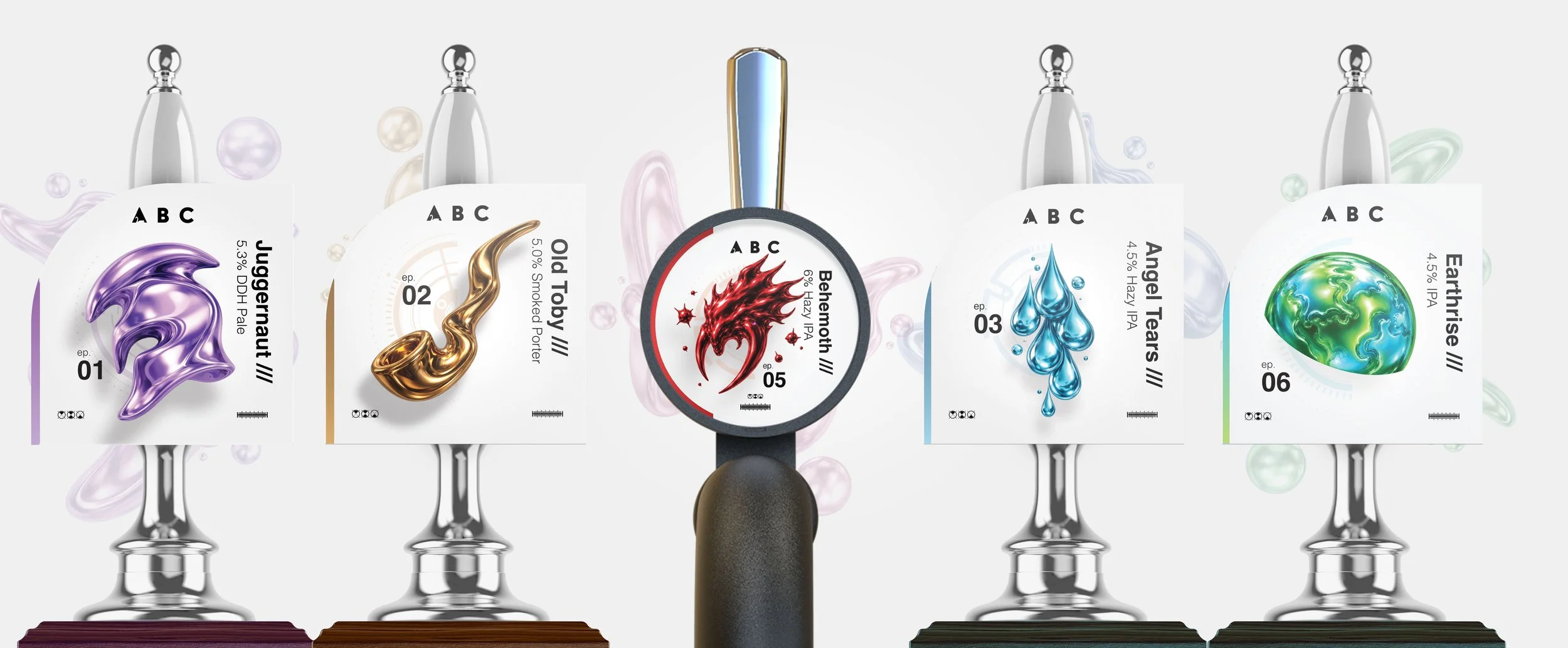
Independent brewery core beer range using a consistent brewery branding and packaging system.
Brand messaging and tone of voice
A brewery also needs to know what it wants to say and how it should say it.
Brand messaging covers the central ideas that need to be communicated repeatedly. Tone of voice determines how those ideas sound.
This might include:
A simple explanation of the brewery
Its positioning or core proposition
The story behind the business
Beer descriptions
Trade messaging
Website copy
Social media language
Taproom communication
Campaign headlines
The language used by the sales team
The aim is not to write everything in exactly the same way.
A trade presentation and an Instagram caption naturally have different jobs. They should still feel as though they came from the same people.
The biggest test is clarity. Brewery owners often know their own business so well that they describe it using language only people inside the brewery fully understand.
Drinkers should not need to read an essay to work out why you matter.
The complete brewery experience
Branding continues beyond the label.
It includes what happens when someone:
Visits your website
Walks into your taproom
Receives an online order
Speaks to your sales team
Sees you at a festival
Opens a mixed case
Signs up for your beer club
Reads a delivery note
Attends one of your events
Encounters a problem
A brewery promising warmth, community and an open welcome will quickly undermine that position if its taproom feels unfriendly or its online service becomes hard work.
Every part of the experience either reinforces the brand or weakens it.
The five jobs of a strong brewery brand
There are loads of things a brewery brand can do, but I keep coming back to five essential jobs.
1. Get noticed
People cannot choose a brewery they do not notice.
Your brand needs enough distinction to break through in the environments that matter, whether that is a pub bar, bottle shop, festival, online store or social feed.
Standing out does not automatically mean being louder, brighter or stranger than everybody else. It means being recognisably yours.
If the answer is always another neon colour, another unusual beer name or a busier illustration, the brewery can end up competing for attention with itself.
Real distinction comes from consistently owning a recognisable idea and visual world.
2. Be understood
Attention only gets you so far.
People also need to understand what they are looking at.
A drinker should be able to work out who made the beer, what sort of beer it is and whether it is likely to suit them. A publican or buyer should understand how the brewery fits their venue, range or customer base.
Your wider message needs the same clarity.
Are you a dependable local brewery known for brilliantly kept cask beer? A modern lager specialist? A brewery built around experimentation? A brewpub rooted in a particular community?
Trying to communicate everything at once usually leaves people remembering very little.
3. Make choosing easier
Buying beer can involve more thought than breweries sometimes realise.
A drinker is faced with different styles, strengths, formats, price points and brands. A buyer may be comparing margins, rate of sale, reliability, customer demand and how well the beer fits the rest of the range.
Good branding reduces that effort.
Clear hierarchy, familiar design cues, useful beer descriptions and a well-structured range all help people reach a decision more confidently.
This is especially important when the brewery offers a large number of beers.
The more products you add, the harder the brand system needs to work.
4. Be remembered
Being noticed once has limited value if nobody remembers you later.
Memory grows through consistent repetition.
That might be the same distinctive colour appearing across a range, a recognisable illustration style, a clear attitude, a memorable name or a particular story that people associate with the brewery.
Consistency should not be confused with sameness. You can keep producing fresh work without starting from scratch every time.
The strongest systems repeat the right things and vary the rest.
5. Give people a reason to return
The final job is turning initial interest into preference and loyalty.
That means delivering on what the brand promises.
If the packaging feels considered, the beer needs to feel equally considered. If the brewery talks about community, people need to experience that community. If the brand presents itself as reliable and straightforward, trade customers need to receive reliable and straightforward service.
Branding can encourage the first purchase. The business behind it creates the second, third and tenth.
What is the difference between a brewery brand and a beer brand?
The brewery brand represents the business as a whole.
It includes the brewery’s reputation, story, values, personality, identity and the experience surrounding everything it produces.
A beer brand represents an individual product or a defined range of products.
Some breweries lead strongly with the master brewery brand. Every beer clearly belongs to the same family and contributes recognition back to the brewery.
Others give individual beers much greater independence. The product name and artwork take priority, while the brewery plays a smaller supporting role.
There is also a hybrid approach. The brewery remains clearly recognisable, but individual beers are given enough freedom to express their own stories and personalities.
There is no single model that suits every brewery.
The right decision depends on:
How established the brewery name already is
Whether drinkers search for the brewery or individual beers
The size and complexity of the range
How frequently new beers are released
The sales channels being targeted
Whether the core range needs to build long-term recognition
How much equity already exists in individual beer names
For many independent breweries, a stronger master brand makes recognition easier to build. Instead of beginning again with every release, each beer adds another small deposit into the same memory bank.
What problems can brewery branding solve?
Branding cannot fix poor beer, unreliable service, weak margins or a route-to-market problem on its own.
It can solve many of the problems that make a good brewery harder to notice, understand and buy.
Your packaging blends in
The fridge is full of highly designed cans, bold colours and intricate illustrations. Simply looking professional is no longer enough.
A clearer visual system can make the brewery more recognisable and help its products hold together as a range.
Your beer range has become confusing
What started with three core beers has grown into seasonal ranges, collaborations, specials, experiments and multiple formats.
Naming becomes inconsistent. Nobody knows which beers are permanent. Customers struggle to understand where to begin.
Brand architecture can organise the range and give each part a clear role.
Nobody can explain what makes the brewery different
The team talks about quality, passion, independence and great ingredients. So does nearly every other brewery.
Brand strategy can uncover a position that feels more specific, ownable and useful.
The business has outgrown its original identity
Plenty of breweries begin with a logo created quickly and cheaply because there is beer to brew and a business to launch.
That identity may have done its job perfectly well at the beginning. Five or ten years later, the brewery may have a taproom, a much larger range, wider distribution and very different ambitions.
The brand needs to catch up with the business it now represents.
Marketing feels disconnected
Every campaign looks and sounds different. Social media relies on whatever needs promoting that week. The website tells one story while the packaging tells another.
A clearer brand gives marketing a central idea to build from.
Sales depend too heavily on the founder
Many independent breweries grow through the energy, knowledge and relationships of one or two people.
That works until the brewery needs somebody else to tell the story, open accounts or represent the business.
Clear positioning, messaging and sales materials make the brand easier for the whole team to communicate.
New releases are overshadowing the core range
Limited releases can generate excitement, but core beers create familiarity, repeat purchase and dependable revenue.
A stronger range strategy can make sure innovation attracts attention without allowing the beers that support the business to disappear behind it.
What is the brewery branding process?
Every brewery and project is different, but a useful process normally follows four broad stages.
Stage 1: Get clear
The first stage is understanding what is happening now.
That can include:
Conversations with founders and the wider team
A brand and packaging audit
Customer research
Trade feedback
Competitor reviews
Sales and product performance
Reviewing the customer journey
Looking at future business plans
The important thing is to identify the real problem.
“Make the cans look better” is a request.
Why the cans need to change, what they are failing to achieve and what commercial outcome the new packaging needs to support is the useful brief.
Stage 2: Find your place
Once the situation is understood, the brewery can define the position it wants to own.
This stage can include:
Audience priorities
Positioning
Purpose
Values
Brand personality
Customer promise
Key messages
Tone of voice
Beer-range architecture
Naming principles
This is where the difficult choices happen.
A brand becomes stronger through deciding what matters most, rather than trying to appeal equally to everybody.
Stage 3: Build the brand
The strategy is then turned into something people can see, hear and experience.
Depending on the project, this might include:
Brewery naming
Logo and identity
Typography and colour
Illustration or photography
Brand messaging
Tone-of-voice guidance
Beer naming
Packaging design
Pump clips and keg lenses
Taproom materials
Trade presentations
Website design
Social media templates
The work should be tested across realistic applications as it develops.
A logo can look brilliant on a large presentation slide and fall apart when squeezed onto a keg badge.
Stage 4: Put it to work
A good brand can still fail through a weak launch or inconsistent implementation.
The final stage should cover how the new brand reaches the real world.
That can include:
Packaging production
Website updates
Social media rollout
Trade communication
Distributor materials
Taproom signage
Launch events
Photography and content
Staff guidance
Brand guidelines
A plan for measuring results
The brand needs to work after the presentation has finished and the design files have been handed over.
Want to know more, check out this ‘how to rebrand your brewery guide here’
How long does brewery branding take?
The timescale depends on the size of the brewery, the number of beers and formats involved, how much research is required and how quickly decisions can be made.
A focused audit or consultancy project might be completed in a few weeks.
A full brewery strategy and identity project is normally completed within around 16 weeks. Larger projects involving extensive packaging ranges, websites, taproom spaces or complicated stakeholder approval can take longer.
Production also needs to be considered.
Labels, printed cans, pump clips, boxes, signage and other physical items all have their own lead times. Those deadlines should be built into the plan rather than dealt with at the end.
How much does brewery branding cost?
The cost of brewery branding depends on what the business needs to solve.
A brewery needing an outside review and a clear action plan requires a very different project from one replacing its strategy, identity, full packaging range, website and taproom materials.
As a broad guide, our current starting prices are:
Brewery consultancy and audits from £1,000 plus VAT
Brewery brand strategy from £6,000 plus VAT
Brewery identity and packaging from £8,000 plus VAT
Complete brewery rebrands from £15,000 plus VAT
The number of beers, packaging formats, rounds of development and supporting materials can all affect the final figure.
The most useful question is not simply, “How much will the branding cost?”
You also need to ask what the current brand is costing the brewery through missed recognition, confusing packaging, weaker sales tools, lost trade opportunities or marketing that fails to build any lasting value.
Does your brewery need a full rebrand or a smaller refresh?
Not every brewery with a branding problem needs to replace everything.
Sometimes the foundations are still strong, but the way they are being expressed needs improving.
A smaller refresh may be enough when:
The brewery still has a clear and relevant position
The name and reputation carry useful recognition
The main identity remains distinctive
The packaging system needs simplifying or modernising
Messaging has become inconsistent
The range needs better organisation
Certain touchpoints have fallen behind
A fuller rebrand may be needed when:
The business has changed direction
The existing brand reflects a brewery that no longer exists
The position is unclear or too generic
The identity creates the wrong impression
The brewery needs to connect with a different audience
The range has become impossible to navigate
Recognition is weak across every major touchpoint
The current brand is actively getting in the way of growth
A proper audit should come before the decision.
Changing less can be the smarter option when the brewery already owns something valuable. Equally, protecting everything through fear of upsetting existing customers can leave the real problem untouched.
How do you measure whether brewery branding has worked?
A rebrand launch often produces a rush of compliments.
People like the new cans. The team feels excited. Social engagement jumps for a few days.
That is encouraging, but it is not the complete measure of success.
The right metrics depend on what the project was created to achieve.
They might include:
Distribution growth
New trade accounts
Rate of sale
Repeat orders
Core-range performance
Online conversion
Taproom footfall
Beer-club membership
Direct-to-consumer sales
Trade enquiries
Retail listings
Average order value
Brand recognition
Customer understanding
Marketing engagement
Sales-team confidence
In our work with Vale Brewery, the new brand helped support a 200% increase in distribution, an additional £75,000 in annual sales secured within two weeks of the soft launch and a beer club that grew from zero to 180 members in under four months.
Wilful Beer secured 12 new trade accounts within eight weeks of launching its new strategy and identity.
Those results did not come from changing a logo in isolation. The strategy, story, identity, packaging and commercial activity worked together.
Common brewery branding mistakes
Starting with the logo
The logo is easier to discuss than positioning, audiences or commercial problems, so it often becomes the starting point.
That can produce a better-looking version of the same unclear brand.
Following whatever is currently popular
Trends can provide useful inspiration, but they are a weak foundation for long-term recognition.
When a whole category starts using similar illustration styles, colours, naming structures or visual tricks, following the trend helps the brewery blend in more professionally.
Giving every beer a completely separate identity
This can create brilliant individual labels while leaving the brewery with very little recognition of its own.
Every release starts the job again.
Trying to appeal to everybody
A broad audience can sound commercially sensible. In practice, it often leads to vague messaging and a brand with very little personality.
Being clear about your priority audiences does not prevent anybody else from buying the beer.
Confusing personal taste with effectiveness
The founder may dislike yellow. The brewer might prefer traditional typography. Somebody on the sales team might want packaging that resembles a successful competitor.
The more useful question is whether the work communicates the agreed strategy and helps the brewery achieve its objective.
Launching without a plan
A new identity needs more than a date when the new cans arrive.
Your team, customers, trade partners and distributors need to understand what is changing, why it is changing and how the new brand should be used.
Measuring success through social engagement alone
Likes and comments can indicate attention, but they do not automatically show that the range is easier to buy or that more beer is being sold.
Decide what success means before the project begins.
Where should an independent brewery start?
Start with the business problem.
What is happening that needs to change?
Perhaps the brewery is struggling to build recognition. The range has become confusing. Trade growth has stalled. The business has moved forward while the brand has stayed in the same place.
Write the problem down as clearly as you can.
Then look at the evidence.
Speak to drinkers, customers, team members, publicans and distributors. Review which beers sell, where enquiries come from, what people remember and where they become confused.
Finally, decide what result the work needs to achieve.
That might be:
Make the core range easier to recognise
Win more local trade accounts
Improve supermarket readiness
Attract younger drinkers without alienating loyal customers
Bring several disconnected ranges together
Give the sales team a clearer story
Increase repeat taproom visits
Prepare the brewery for its next stage of growth
A useful brief connects the problem, evidence and desired result.
Once those three things are clear, you can decide whether the right next step is an audit, a strategy project, a packaging refresh or a complete rebrand.
Brewery branding should help sell more beer
A strong brewery brand should make the business easier to notice, easier to understand and easier to choose.
It should bring the beer range together, give marketing something recognisable to build and help the sales team explain why the brewery deserves a place on the bar, shelf or drinks list.
Most importantly, it needs to work in the real world.
The fridge. The pub. The taproom. The trade meeting. The online shop. The moment someone asks for your beer by name.
That is where brewery branding earns its keep.
Is your brewery brand pulling its weight?
If your packaging is blending in, the range has become confusing or the brewery has outgrown the brand around it, let’s take a proper look at what is happening.
We help independent breweries sharpen their strategy, improve their identity and packaging, connect with more drinkers and sell more beer.
Frequently asked questions about brewery branding
What is brewery branding?
Brewery branding is the strategy, identity, packaging, messaging and customer experience that shapes how people recognise and understand a brewery. It includes far more than the logo and should help drinkers and trade customers notice, remember and choose the brewery.
What should a brewery brand include?
A complete brewery brand can include positioning, audience strategy, values, personality, messaging, tone of voice, visual identity, beer naming, packaging, range architecture, website design, taproom materials, trade communication and marketing guidance. The exact requirements depend on the size and goals of the brewery.
Is brewery branding just the logo and beer labels?
No. The logo and labels are visible parts of the brand, but they are built on wider decisions about who the brewery is for, what makes it different, how its range is structured and what it wants to be known for. Branding also affects the website, taproom, sales materials, events, service and marketing.
What is the difference between brewery branding and beer branding?
Brewery branding represents the business as a whole, while beer branding relates to an individual product or range. Some breweries lead strongly with the brewery name across every beer. Others give individual products more independence. The right approach depends on existing recognition, range size, sales channels and business strategy.
How much does brewery branding cost?
Brewery branding costs vary according to the size of the project. Consultancy and audits may begin from around £1,000 plus VAT, while complete brewery rebrands involving strategy, identity and packaging can start from £15,000 plus VAT. The number of beers, formats and supporting materials will affect the final cost.
How long does a brewery rebrand take?
A complete brewery strategy and identity project will normally take around 16 weeks. Smaller audits, strategy projects or packaging refreshes may be completed more quickly. Larger ranges, websites, taproom applications and production requirements can extend the timescale.
Can an established brewery rebrand without losing existing customers?
Yes, provided the brewery understands which parts of its existing reputation and identity customers genuinely value. Research, clear communication and a considered rollout can protect useful recognition while improving the parts of the brand that are holding the business back.
How can a brewery measure branding success?
Useful measures can include distribution, trade accounts, rate of sale, repeat purchase, online conversion, taproom visits, beer-club membership, customer recognition and sales-team confidence. The right measurements should be agreed before the branding project begins and connected to the brewery’s commercial goals.